The company brain: what it is and why your AI needs one
Every company already has a brain. It is just scattered across databases, shared drives, chat threads and the heads of a few people. A company brain is what happens when that knowledge becomes one layer that AI can query, act on and be held accountable for.
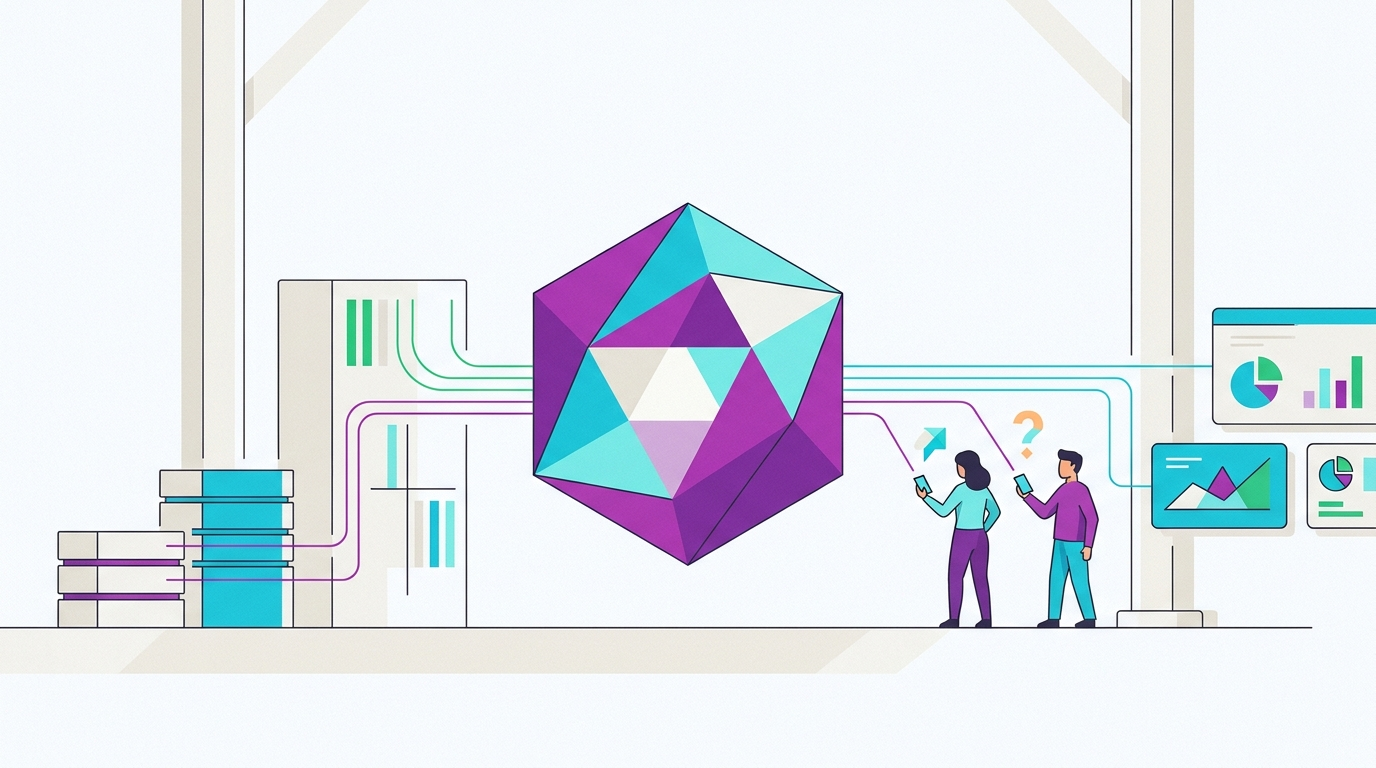
A newly hired analyst asks what the maximum discount for distributors is. The honest answer, in most companies, is "it depends on who you ask".
Part of it is in a commercial policy PDF from two years ago. Another part is in the ERP price table. The exception for the three largest customers is in an email thread. And the reason the exception exists is in the head of someone who has been with the company for twelve years.
None of those sources is wrong. The problem is that none of them, alone, is the answer. That is the problem the idea of a company brain sets out to solve.
Every company already has a brain, it is just scattered
A company's knowledge lives in four places:
- In systems. ERP, CRM, databases: the facts. What was sold, to whom, for how much, when.
- In documents. Policies, contracts, manuals, procedures: the rules.
- In processes. The report someone assembles every Monday, the check done before an order is released: how the work really happens.
- In people. The context, the exceptions and the reasons behind them.
Those four places almost never talk to each other. The cost shows up in familiar ways: hours spent looking for information, decisions made with half the picture, the same report rebuilt by three departments with three different numbers, and knowledge that leaves when someone resigns.
For a long time this was treated as an unavoidable nuisance. With AI, it became a ceiling.
Why this became urgent now
AI models have become a commodity. Your company and your competitor have access to exactly the same models, at the same price. What your competitor does not have is your order history, your returns policy and the accumulated knowledge of your team.
An AI agent without that context is a brilliant consultant on their first day: it writes well, reasons well and knows nothing about your company. It answers what is true in general, not what is true inside your walls. We compared the two scenarios in We already use Claude Code and Codex. Why would we need Orkindo?.
There is a side effect, too. When the company offers no official place to ask, people build their own: they copy company data and paste it into personal tools. That is the origin of much of what we described in Shadow AI.
The difference between generic AI and useful AI is not the model. It is what the model can see and do inside the company.
What a company brain is not
The term is being used for many things. It is worth separating them.
- It is not a chatbot on top of a folder of PDFs. That answers what is written in the documents, but has no idea how much was sold yesterday.
- It is not a wiki. A wiki depends on someone writing it and keeping it current, which is exactly what nobody has time to do.
- It is not a data warehouse. That stores the numbers, but not the rules that give them meaning, and it still needs an analyst between the question and the answer.
- It is not a giant prompt. Pasting the company handbook into an assistant's instructions works until the handbook's second update.
Each of those pieces holds a fragment. A brain is what connects the fragments.
The three things a company brain does
1. It knows
A company brain is connected to the sources where they already live: databases, documents, internal tools. It does not depend on someone exporting a spreadsheet on Friday.
The test is simple. A manager asks, in plain English, "what were our top products last week?" and gets the table straight from the sales database, with the source cited, in seconds. No SQL, and no ticket to the data team.
The real value appears when the answer crosses sources. A customer wants to return an order: the purchase date is in the database and the return window is in a document. Only a brain that reads both can answer "yes" or "no".
2. It acts
Knowing is not enough. A large share of a company's work is taking information from one place to another at the right moment: the production summary every morning, the alert when inventory crosses its minimum, the invoice batch checked before payment.
A company brain orchestrates that as autonomous workflows, on schedules or triggered by events. The same intelligence that answers the manager's question also delivers the report before they ask. And when the work calls for more than one specialty, it coordinates a team of agents, as we showed in Agents as teammates.
3. It is governed
A brain with access to everything and no control is a liability, not an asset. The third function is what allows the first two to exist:
- Role-based access. The sales rep sees their own customers, not the payroll.
- Audit. Every lookup and every action is logged: who asked, what was read, what was done.
- Traceability. Every answer points to the source it came from.
That discipline is what lets a bank open its compliance policies to every employee and still show the regulator every single lookup.
Why the brain grows more valuable over time
Isolated tools have linear returns: each new assistant starts from zero. A company brain has compounding returns.
Every database, document or tool you connect becomes context available to every agent that follows. The churn alert agent reuses the CRM schema that was already connected for the sales report. The tenth agent takes a fraction of the effort of the first, because nothing needs to be explained again.
It is also what protects the company from turnover: knowledge stops walking out the door with the person who carried it.
How to start
Nobody builds a whole brain at once. The path that works is incremental.
- Pick one question that hurts. The one somebody asks every week and that costs an analyst hours to answer.
- Connect that question's sources where they are. Usually one database and one or two documents, with read-only credentials.
- Define who can see what before opening it up. Governance on day one is cheap. After the first leak, it is expensive.
- Put the answer where people already work. WhatsApp, Slack, Teams. If it means opening one more system, nobody will use it.
- Make it act. When the question keeps coming back, turn it into a scheduled workflow that delivers the answer by itself.
Then repeat with the next question. Each lap makes the following one shorter.
The most common traps
- Waiting for the data to be clean. It never will be. Start with the source that is already reliable enough for today's decisions.
- Copying everything to a new place. A two-year migration project is not a brain. Connect the sources where they live.
- Opening it up without governance. One answer containing data the person should not have seen is enough for the project to lose the company's trust.
- Stopping at the answer. A brain that only answers is a better search engine. The big gain comes when it also executes.
Where Orkindo fits
Building the brain of your company is what Orkindo does. It connects to your databases, documents, internal tools and communication channels and brings everything into a single layer of intelligence, built on three pillars:
- Centralized. Anyone with permission asks in natural language on WhatsApp, Google Chat or web chat and gets tables, charts and source-cited answers.
- Orchestrated. Autonomous workflows run on schedules or events, coordinating data and tools.
- Governed. Role-based access on every system, database and knowledge source, a full audit log, token usage tracking and traceability on every action.
Each new connection adds context, and the Orkindo assistant uses that context to help build the next flow, app or agent. The first agent is usually in production within two weeks.
The takeaway
To size the problem in your company, one question is enough:
If the best-informed person on your team left tomorrow, how much of what they know could the company still use?
If the answer is uncomfortable, your company's brain is still scattered. The good news is that it does not have to be built from scratch: the knowledge already exists. It just needs to be connected.
If you want to start with the first question, book a call.