Company brain vs. RAG vs. knowledge base vs. enterprise search
RAG is a technique, a knowledge base is a curated collection and enterprise search is a way to find things. A company brain is the governed layer that uses all three, reads live data from the systems and also acts. Here is what each one solves and where it stops.
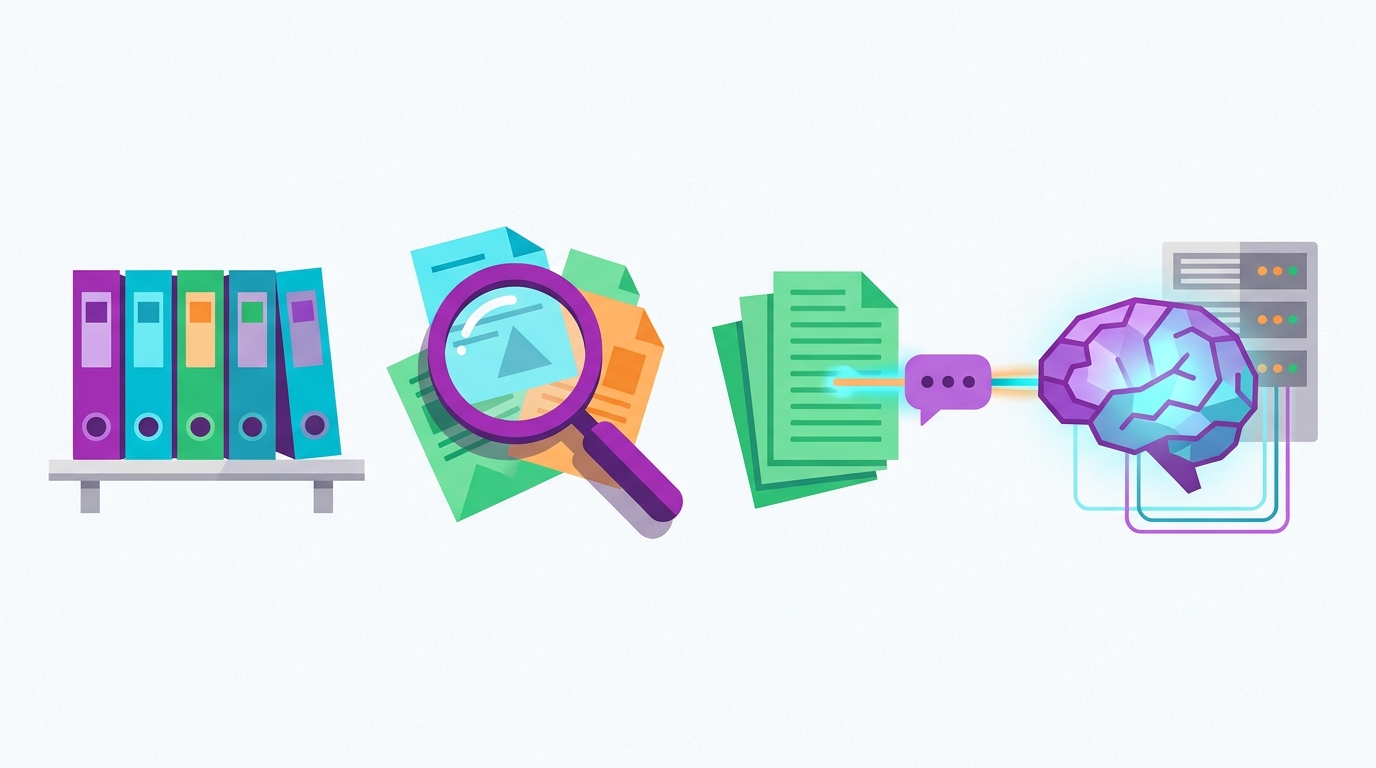
Short answer: the four terms are not competitors, because they sit at different levels. RAG is a technique for giving documents to a model. A knowledge base is a curated collection of articles. Enterprise search is a way to find where something is. A company brain is the governed layer that uses all three, reads live data from the systems where it lives and also executes work. If your questions are only about what is written in documents, you may not need a company brain yet.
A meeting about AI usually takes ten minutes to reach this point. Someone says "we already have this, it is our RAG". Someone else says "that is what the wiki is for". A third person remembers the search tool the company bought last year.
All three are right about what they have. They are describing different things, and none of them is describing a company brain. If the term is new to you, start with what a company brain is.
Why do these four terms get confused?
They get confused because all four promise the same result: an employee asks a question and gets the company's answer. The difference is in how far each one goes to deliver it.
A useful way to separate them is to ask four things about any tool:
- What can it read? Only written documents, or also the live data in the ERP and the CRM?
- What does it return? A link, a passage or a finished answer?
- Who keeps it up to date? A person who writes, an index that syncs, or the source itself?
- Can it do anything? Or does it stop when the answer is delivered?
The sections below apply those four questions to each term.
What is RAG, and where does it stop?
RAG (retrieval-augmented generation) is a technique: before the model answers, the system retrieves the passages most related to the question and hands them to the model as context. It is what makes an assistant answer from your policy PDF instead of from what it learned in training.
RAG solves a real problem well. The model stops inventing rules, the answer comes with the passage it was based on, and updating the knowledge means updating the document, not retraining anything.
Where it stops, in its most common form (a pipeline over a folder of documents):
- It only knows what was indexed. If the answer is a number in the sales database, there is no passage to retrieve.
- It retrieves by similarity, it does not compute. "How much did we sell last week" is not a passage of text. It is a query.
- Permissions are your problem. The technique says nothing about who is allowed to see which passage. Someone has to build that.
- It ends at the answer. RAG does not schedule a report or open a ticket.
None of this is a defect. RAG is a component, and judging it as a full system is the mistake.
What is a knowledge base, and where does it stop?
A knowledge base is a curated collection of articles written by people: the wiki, the help center, the procedures manual. It is the only one of the four where a human decided, sentence by sentence, what the official answer is.
That is its strength. A well-maintained article is the most authoritative source a company has, and it is the best raw material for any AI layer placed on top.
Where it stops:
- It only holds what someone wrote. The exception agreed by email last month is not there.
- It depends on upkeep. An article nobody owns becomes wrong without anyone noticing.
- It does not hold facts. The return policy is there. The date of the customer's order is not.
- The reader does the work. They find the article, read it and apply it to their case.
What is enterprise search, and where does it stop?
Enterprise search indexes the company's applications (drive, email, chat, tickets, wiki) and lets a person search all of them in one place. The good products respect each source's permissions and, more recently, summarize the results with a model.
It solves the problem of "I know this exists, I do not know where". In companies with dozens of tools, that alone gives back hours every week.
Where it stops:
- It finds, it does not conclude. The typical result is a list of links, or a summary of what the links say.
- Live systems are usually out of reach. Searching documents about sales is different from querying the sales database.
- It does not cross sources into one decision. It shows the policy and the order. Putting the two together is still up to the person.
- It does not act.
What is a company brain?
A company brain is a single governed layer that connects a company's systems, documents, processes and tools so that AI can answer with the company's own data, act on it through autonomous workflows and leave an audit trail of everything it reads and does.
Against the four questions:
- It reads documents and live data, at the source, without copying everything to a new place.
- It returns the finished answer, with the sources cited, even when the answer needs a database and a document at the same time.
- The sources keep it up to date, because it queries them where they live.
- It acts: the same layer that answers also runs workflows on schedules or events.
All of it runs under role-based access and audit, which is what allows the other three points to exist in a real company.
How do the four compare side by side?
| Criterion | Knowledge base | Enterprise search | RAG over documents | Company brain |
|---|---|---|---|---|
| What it is | A curated collection | A search product | A technique | A governed layer |
| What it reads | Articles written for it | Indexed content from many apps | The documents you index | Documents and live systems, at the source |
| What it returns | An article to read | Links, sometimes a summary | An answer based on passages | A finished answer, with sources |
| Live data (ERP, CRM, databases) | No | Rarely | Not in the usual form | Yes |
| Crosses sources in one answer | No | No | Only among indexed documents | Yes |
| Who keeps it current | Whoever writes the articles | The index sync | Whoever re-indexes | The sources themselves |
| Permissions | By space or page | Inherited from the sources, in good products | You build them | By role, on every source |
| Audit of what was read | Limited | Varies by product | You build it | Built in |
| Executes work | No | No | No | Yes, through workflows |
| Good fit for | Official procedures | Finding where something is | Questions about written content | Questions and tasks that cross systems |
What does the same question look like in each one?
Take a question a support agent asks every day: "can this customer still return order 4812?". In this example the order was placed 21 days ago and the policy allows returns within 30 days.
| Tool | What the agent gets | What is still left to do |
|---|---|---|
| Knowledge base | The "Returns policy" article, if it is up to date | Read it, look up the order date in another system, do the math |
| Enterprise search | Links to the policy PDF and to conversations about returns | Open the links, look up the order, do the math |
| RAG over documents | "Returns are accepted within 30 days of purchase", with the passage cited | Look up the order date, do the math |
| Company brain | "Yes. Order 4812 was placed 21 days ago and the window is 30 days", with both sources cited | Nothing. If the agent's role allows it, the brain can also open the return request |
The first three answers are correct. They just stop one step before the decision, and that last step is where the agent's time goes.
When are RAG, a knowledge base or enterprise search enough?
Often. A company brain is not the right answer to every problem, and buying one too early is a real way to waste money.
- A knowledge base is enough when the questions are about stable procedures and there is someone who owns the content.
- Enterprise search is enough when the pain is finding things, and the people searching know what to do with what they find.
- RAG over documents is enough when the answers are in the text, the content is not sensitive and one team uses it.
The sign that you have outgrown them is always the same: the answers people need depend on data that lives in systems, on more than one source at a time, or on someone doing something after the answer arrives.
Does a company brain replace the other three?
No. It uses them. Retrieval over documents is one of the ways a company brain reads what is written, so RAG is inside it. A well-kept knowledge base is one of its best sources. And a company that already has enterprise search has already done part of the work of mapping where its knowledge lives.
That also means nothing you built is wasted. The policies you wrote, the documents you indexed and the prototype someone on the data team assembled all tell you which questions matter. What they do not give you is the layer around them: connectors to live systems, permissions, audit and execution. We broke down what that layer costs in build or buy a company brain.
How do I know which one I already have?
Ask these six questions about the tool your company calls "our AI" today:
- Does it answer with yesterday's numbers, or only with what is written in documents?
- Can it combine a database and a document in the same answer?
- Do two people in different roles get different answers to the same question?
- Is there a record of who asked what and which sources were read?
- Does every answer point to where it came from?
- Can it run a task on a schedule, without anyone asking?
If the answer is "yes" only to the fifth, you have RAG. If it is "yes" to all six, you have a company brain, whatever name it goes by.
Where Orkindo fits
Orkindo is a company brain. It connects to your databases, documents, internal tools and communication channels, and brings them into a single layer where anyone with permission asks in natural language on WhatsApp, Google Chat or web chat and gets tables, charts and source-cited answers.
Retrieval over your documents is part of it, next to live queries on your databases and autonomous workflows that run on schedules or events. Everything goes through role-based access and a full audit log. The first agent is usually in production within two weeks.
If you want to see where your current setup stops, book a call.
Frequently asked questions
Is a company brain just RAG with a new name?
No. RAG is a technique for retrieving passages from documents and handing them to a model. A company brain uses that technique, and adds live queries on systems such as the ERP and the CRM, role-based access, an audit log and workflows that execute work.
Do I need RAG if I have a company brain?
You already have it. Retrieval over documents is one of the ways a company brain reads written content such as policies and contracts. What changes is that it is no longer the only way the AI gets to the company's knowledge.
What is the difference between enterprise search and a company brain?
Enterprise search finds where the information is and returns links or a summary. A company brain returns the finished answer, combining documents with live data from the systems, and can also execute the task that follows, under role-based access and audit.
Does a company brain replace our wiki or knowledge base?
No. A well-maintained knowledge base is one of the best sources a company brain can have, because a person decided what the official answer is. The brain reads it where it lives and combines it with the facts held in the systems.
When is plain RAG over documents enough?
When the answers are in the text, the content is not sensitive and a single team uses it. Once the questions depend on live data, on more than one source or on permissions that differ by role, RAG alone stops being enough.